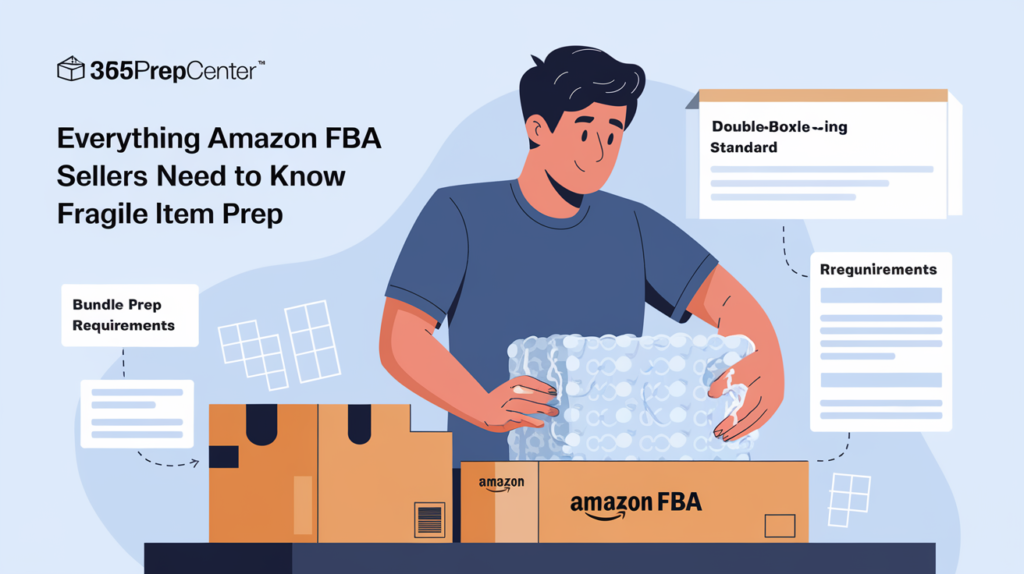
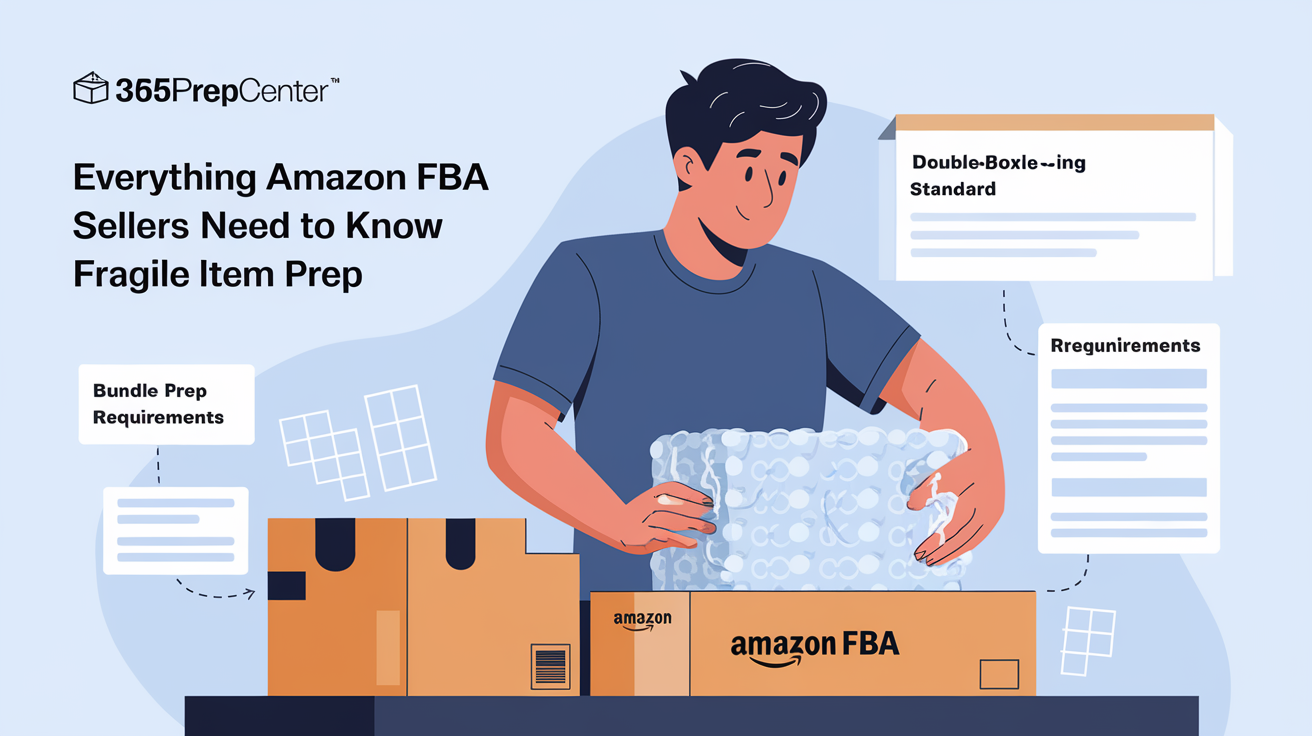
Amazon FBA Fragile Items: Bubble Wrap, Padding & Full Prep Requirements
You’ve sourced the perfect product, shipped it to an Amazon fulfillment center, and then the damage reports start rolling in. Glassware arrives shattered. Ceramic mugs crack in transit. Fragile bundles get rejected at the receiving dock. For experienced Amazon sellers, fragile item prep is one of the most unforgiving areas of FBA — a single misstep in packaging doesn’t just cost you the product, it triggers negative reviews, stranded inventory, and potential suspension flags. Understanding Amazon FBA fragile items prep requirements in full is not optional; it’s a competitive necessity.
What Amazon Defines as a Fragile Item
Amazon classifies fragile items as any product that can break, shatter, or become damaged under normal handling and shipping conditions. This includes, but is not limited to:
- Glassware, stemware, and glass containers
- Ceramic and porcelain products
- Snow globes and decorative figurines
- Electronics with exposed screens or delicate components
- Mirrors and framed artwork
- Liquids in glass bottles
- Musical instruments with fragile parts
Amazon’s internal handling systems are automated and high-volume. Conveyors, chutes, and robotic picking arms are not calibrated for delicate treatment. If your product can’t survive a 3-foot drop onto a hard surface, it requires fragile item prep — no exceptions. Amazon’s official packaging guidelines state that items must be able to withstand normal warehouse and shipping conditions without the outer packaging failing or the product sustaining damage. That standard is the baseline you’re building toward.
It’s also worth noting that Amazon does not differentiate based on product cost. A $4 glass spice jar and a $400 crystal vase are both subject to the same prep requirements. Your packaging has to carry the full load.
Amazon’s Official Fragile Item Prep Requirements
Meeting Amazon FBA fragile items prep requirements starts with understanding what Amazon specifically mandates. According to Amazon’s FBA packaging and prep requirements, fragile items must be wrapped so that the item is fully protected and that the packaging can withstand a 3-foot drop test on all sides — top, bottom, and each face — without the item breaking or the packaging bursting open.
Here are the core requirements broken down:
- Full enclosure: Fragile items must be completely enclosed in protective material, not just padded on one side.
- No sharp edges exposed: If a product has corners or protrusions that could puncture packaging, those areas need reinforced protection.
- Must pass the drop test: The fully packaged unit should survive a 3-foot drop without breaking or opening.
- Bubble wrap must be secured: Loose bubble wrap that can shift during transit does not qualify — it must be taped or sealed to stay in position around the item.
- Poly bag or overwrap if liquid: Glass containers with liquids require an additional poly bag seal to contain any potential leakage.
Amazon’s data shows that improper packaging is one of the leading causes of FBA inventory damage claims. According to Amazon’s Seller Central documentation, prep defects — including insufficient fragile packaging — can result in receiving refusals and unfulfillable inventory status, which directly impacts your IPI score and reimbursement eligibility.
Bubble Wrap: The Right Way vs. The Wrong Way
Bubble wrap is the most commonly used fragile item prep material, and it’s also the most commonly misapplied. Using bubble wrap incorrectly gives sellers a false sense of security while leaving products vulnerable to damage.
The Right Way to Apply Bubble Wrap
- Use the correct bubble size: Small bubbles (3/16″) work best for lightweight, delicate items with fine detail. Large bubbles (1/2″) provide better cushioning for heavier fragile items like thick glass or ceramics.
- Wrap in multiple layers: A single layer of bubble wrap rarely meets Amazon’s drop test standard. Two to three layers — especially around edges and corners — is the professional standard.
- Tape every seam: Every fold and edge of bubble wrap must be taped closed. An unwrapped corner is an unprotected corner.
- Bubble side in: The bubble side should face the product, not the exterior. This maximizes the cushioning effect where it’s needed most.
- Leave no dead space: If there’s room for the item to shift inside the box, add void fill. Movement inside packaging is a primary cause of breakage.
Common Bubble Wrap Mistakes
- Single-layer wrapping on heavy glass items
- Using old, deflated bubble wrap that no longer provides cushion
- Wrapping with bubbles facing outward
- Leaving taped seams at the most impact-prone corners
- Skipping tape entirely and relying on box compression to hold the wrap in place
Sellers who take fragile item prep seriously treat bubble wrap as an engineered solution, not a quick fix. Every wrap decision has a reason behind it.
Padding, Void Fill, and Secondary Packaging Options
Bubble wrap alone isn’t always the right answer. Depending on the product type, weight, and shape, other padding materials may perform better — or need to be used in combination with bubble wrap to meet Amazon FBA fragile items prep requirements.
Foam Wrap and Foam Pouches
Foam wrap offers a softer, scratch-free alternative to bubble wrap and is particularly effective for items with intricate surface details — think etched glassware or polished ceramic finishes. Foam pouches allow for quick, consistent wrapping without tape and are a popular choice for high-SKU fragile prep operations.
Air Pillows and Void Fill
Once the item is wrapped, the box itself needs to be filled. Air pillows, packing peanuts, crumpled kraft paper, or foam-in-place systems all serve as void fill. The goal is zero movement. If you shake the finished box and hear anything shift, it’s not ready for FBA. Air pillows are generally preferred for FBA prep because they’re lightweight (keeping shipping costs down) and don’t compress over time like paper-based fill.
Double-Boxing
For especially high-value or exceptionally fragile items — antique glass, large mirrors, high-end audio equipment — double-boxing is the gold standard. The product is wrapped and placed in an inner box with padding, and that inner box is then placed inside a larger outer box with additional padding on all six sides. This approach significantly exceeds Amazon’s minimum standards and dramatically reduces damage rates.
Fragile Stickers and “This Side Up” Labels
Amazon does not require fragile stickers, and their fulfillment staff cannot guarantee careful handling based on external labeling. However, applying fragile stickers and directional labels can reduce damage risk during the inbound shipping phase — before the unit reaches the FC. Use them during the carrier leg of your shipment even if they don’t carry weight inside Amazon’s walls.
Fragile Item Prep for Bundles and Kits
Selling fragile items as part of a kit or bundle introduces a layer of complexity that single-unit prep doesn’t cover. Now you have multiple fragile components that must survive transit together without damaging each other — and the entire bundle must arrive as a complete, sellable unit.
When bundling fragile items, each component needs individual wrapping before the bundle is assembled. A bundle of four wine glasses, for example, requires each glass to be independently bubble-wrapped, then arranged in the bundle box with foam dividers or custom-cut inserts separating each unit. No two wrapped fragile items should be in direct contact with each other inside the bundle packaging.
This is a labor-intensive process that scales poorly when handled in-house. Our kitting and bundling services are specifically designed for exactly this type of complexity — handling multi-component fragile bundles with the same precision standards Amazon requires, so your kits arrive intact and ready to fulfill.
If you’re building product bundles that include fragile items and want to understand how prep interacts with your bundle strategy, reviewing our full FBA prep services breakdown will give you a clearer picture of what a professional prep workflow looks like end-to-end.
When to Outsource Fragile Item Prep
There’s a point in every FBA seller’s growth where prepping fragile items in-house stops making sense. The labor time required to properly bubble wrap, double-box, and quality-check fragile SKUs is substantial — and mistakes are expensive. A single breakage claim, a receiving refusal, or a batch of negative reviews tied to damaged product can erase the cost savings of DIY prep in a single week.
Outsourcing fragile item prep to a qualified 3PL gives you several tangible advantages:
- Standardized prep processes: Professional prep centers follow the same documented procedure for every unit — no shortcuts, no variability.
- Drop test accountability: Reputable prep centers build drop-test compliance into their quality control workflow.
- Materials at scale: Buying bubble wrap and foam in bulk reduces per-unit prep costs significantly compared to retail purchasing.
- Time reallocation: Every hour not spent wrapping glassware is an hour you can spend on sourcing, listing optimization, or PPC management.
- Amazon compliance confidence: An experienced prep center knows Amazon’s receiving requirements and preps to exceed them, not just meet them.
At 365PrepCenter in Lebanon, Ohio, fragile item prep is a core part of our FBA preparation workflow. We handle everything from individual bubble wrap and foam applications to full double-boxing on high-value SKUs — and we prep to Amazon’s exact specifications so your inventory clears receiving without flags or refusals.
Final Checklist: Amazon FBA Fragile Items Prep Requirements
Before your fragile inventory ships to an Amazon fulfillment center, run through this checklist:
- Item is fully enclosed in bubble wrap or foam — no exposed surfaces
- All bubble wrap seams are taped closed with bubble side facing inward
- Package passes a 3-foot drop test on all six sides
- Zero movement inside the box — void fill used to eliminate dead space
- Glass liquids are poly-bagged in addition to outer packaging
- Bundle components are individually wrapped and separated by dividers
- Outer box is appropriately sized — not oversized, not undersized
- FNSKU label is applied flat, readable, and not covered by tape or wrap
- Fragile stickers applied for inbound carrier handling (optional but recommended)
- Double-boxing applied for high-value or large fragile items
Meeting Amazon FBA fragile items prep requirements consistently is what separates sellers who scale fragile categories profitably from those who absorb constant damage losses. The investment in proper prep materials and process — whether done in-house or outsourced — pays back quickly in reduced damage rates and cleaner account metrics.
Ready to simplify your FBA prep? 365PrepCenter in Lebanon, Ohio handles everything — get a free quote.