Private Label vs. Wholesale FBA Prep: What’s Different and Why It Matters
You’ve dialed in your sourcing strategy — but your prep process is still built around the wrong model. That’s a costly mistake more Amazon sellers make than you’d think. Private label and wholesale are fundamentally different businesses, and treating their FBA prep requirements as interchangeable leads to labeling errors, compliance failures, delayed shipments, and unnecessary fees. Understanding the private label vs wholesale FBA prep difference isn’t a minor operational detail — it directly affects your margins, your seller account health, and how fast your inventory moves from a truck dock to a live listing.
Why the Business Model Determines the Prep Strategy
Before diving into specifics, it helps to reset the framing. Private label sellers are building a brand. Every unit that ships to an Amazon fulfillment center represents their product, their packaging, and their ASIN. Wholesale sellers, by contrast, are moving inventory they didn’t manufacture and don’t exclusively control — they’re competing on a shared listing alongside other sellers.
That distinction creates two completely different sets of prep priorities:
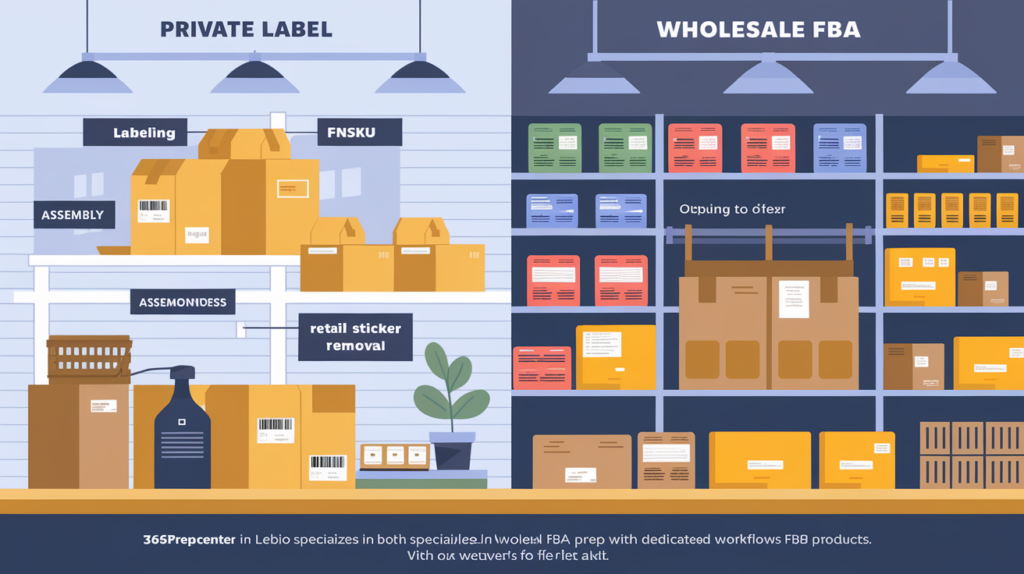
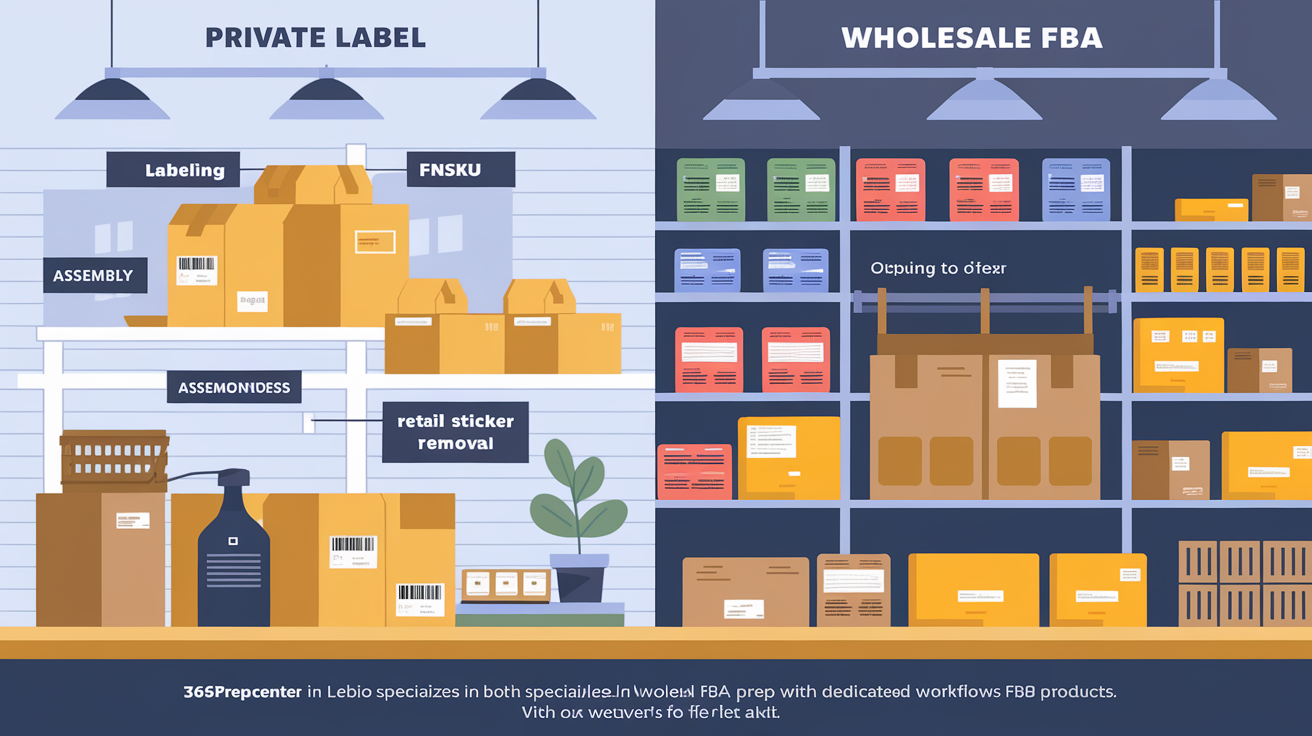
- Private label prep is brand-driven. Consistency, custom packaging, insert cards, and retail-ready presentation matter because every customer experience reflects back on your brand.
- Wholesale prep is compliance-driven. Speed, accuracy, and adherence to Amazon’s FNSKU labeling requirements matter most because you’re working with products that may already carry manufacturer barcodes that need to be suppressed or replaced.
A prep center that understands this distinction — like 365PrepCenter’s full-service offering — can execute both models correctly instead of applying a one-size-fits-all workflow that creates problems downstream.
Private Label FBA Prep: Brand Consistency Is Non-Negotiable
Private label prep is where presentation and compliance intersect. You’ve invested in product development, custom packaging, and photography. The prep process has to protect and extend that investment all the way to the customer’s doorstep.
Key prep elements for private label sellers:
- Custom packaging integrity — Units need to arrive at the fulfillment center exactly as designed. That means no damaged boxes, no crushed corners, no moisture exposure. A prep center should inspect every unit before it goes into a master carton.
- Insert card placement — Many private label sellers include thank-you cards, warranty registration cards, or product instruction cards. These need to be placed consistently inside every unit, not stuffed in randomly or omitted.
- FNSKU labeling over UPC — Your private label product’s UPC is yours, but Amazon still requires an FNSKU label if you’re not enrolled in the brand’s commingled inventory program — and most private label sellers shouldn’t be. Labels must be placed precisely, covering the manufacturer barcode without damaging packaging.
- Poly bagging and suffocation warnings — Many private label products require poly bagging with suffocation warning labels if the bag opening exceeds 5 inches. This is an Amazon policy requirement, not optional.
- Bundle verification — If you sell multi-unit bundles, every bundle needs to be assembled correctly, sealed, and labeled as a single unit with a bundle FNSKU.
The prep workflow for private label sellers tends to be more deliberate and detail-oriented. Turnaround time is often secondary to accuracy — one mislabeled ASIN sent to a fulfillment center in volume can result in a stranded inventory situation that takes weeks to untangle.
Wholesale FBA Prep: Speed, Accuracy, and Barcode Management
Wholesale prep operates at a different tempo. You’re often moving larger quantities of SKUs, working with products that come in retail packaging designed for brick-and-mortar, and competing on listings where velocity matters. The private label vs wholesale FBA prep difference becomes most visible here: wholesale prep is fundamentally about transformation — taking retail-ready product and making it Amazon-ready, fast.
Key prep elements for wholesale sellers:
- FNSKU labeling over existing barcodes — Wholesale products come with manufacturer or retail barcodes that Amazon’s scanners will reject or misroute. Every unit needs a properly placed FNSKU label that covers the original barcode completely.
- Retail sticker removal — Products sourced through retail or distributor channels may have price stickers, clearance tags, or store barcodes that must be removed cleanly before shipment. Residue or torn packaging is a common reason for customer complaints.
- Bubble wrap and fragile item prep — Wholesale catalogs often include fragile items like glassware, electronics accessories, or kitchen tools. Each category has specific Amazon packaging requirements that must be met to avoid a prep compliance strike.
- Expiration date labeling — Wholesale sellers working in grocery, health, or beauty categories must ensure expiration dates are visible on every unit and face outward. Amazon’s policy requires expiration dates to be clearly visible without opening the outer packaging.
- High-volume SKU management — Wholesale operations often involve dozens of SKUs in a single shipment. Accurate count verification, proper box content uploads in Seller Central, and correct placement plans are essential to avoid receiving discrepancies.
According to Amazon’s FBA requirements, all products must be scannable with a compliant barcode — either an approved manufacturer barcode or a seller-applied FNSKU label. Failure to meet this requirement results in items being rejected or assessed a manual processing fee of up to $0.15 per unit at the fulfillment center — a cost that compounds quickly at wholesale volumes.
Where the Two Models Overlap — and Where They Diverge
Both private label and wholesale sellers share a baseline set of FBA prep requirements: compliant barcodes, appropriate packaging protection, and accurate shipment documentation. But the overlap ends quickly once you look at workflow complexity and quality control priorities.
Private label sellers typically ship smaller quantities more frequently as they manage replenishment cycles tied to inventory performance. Wholesale sellers may ship in larger batches less frequently, depending on their supplier lead times and buy quantities. This affects how a prep center should structure receiving, quality inspection, and throughput for each client type.
The private label vs wholesale FBA prep difference also shows up in how returns are handled. Private label returns often require inspection and repackaging before they can go back into FBA inventory — the packaging has to meet the brand standard. Wholesale returns may need a simple FNSKU relabel and reseal if the product itself is undamaged.
At 365PrepCenter, we handle both models with dedicated workflows — not because it’s complicated, but because applying the right process to the right business model prevents costly mistakes before they happen. You can review our full capabilities on our FBA prep services page.
Choosing the Right Prep Center for Your Model
Not every third-party prep center is equipped to handle both private label and wholesale at a high level. When evaluating a prep partner, ask specific questions based on your business model:
For private label sellers, ask:
- Can you handle custom insert card placement at scale without errors?
- Do you have a QC inspection process for incoming inventory, or do you prep and ship without opening master cartons?
- How do you handle bundling — do you have an assembly workflow or is it ad hoc?
- Can you accommodate branded packaging materials or custom polybags we supply?
For wholesale sellers, ask:
- What’s your average turnaround time per unit for receive-to-ship?
- How do you manage multi-SKU shipments — is there a verification step before the shipment plan is submitted?
- Do you have experience with category-specific prep requirements like grocery, hazmat, or oversized?
- How do you handle retail price sticker removal across high-volume units?
These aren’t just due diligence questions — the answers tell you whether a prep center has actually built workflows around these distinctions or is treating every shipment the same way.
Why Getting This Right Directly Impacts Your Profitability
The private label vs wholesale FBA prep difference isn’t academic — it has a direct line to your bottom line. A mislabeled private label unit that gets received under the wrong ASIN creates a stranded inventory event, triggers a removal order, and wastes your cost of goods plus shipping. A wholesale shipment with uncovered retail barcodes results in manual processing fees, delayed receiving, and potentially lost buy box days while units sit unprocessed.
Here’s what most sellers underestimate: the cost of a prep error isn’t just the immediate fee or the reshipment cost. It’s the ripple effect — slower inventory turns, suppressed IPI scores, and the time your operations team spends troubleshooting instead of scaling. A disciplined prep process that’s calibrated to your specific business model eliminates that category of problems almost entirely.
Whether you’re scaling a private label brand with tight packaging standards or running a wholesale operation with high SKU counts and rapid replenishment cycles, the operational infrastructure underneath your FBA strategy matters as much as the sourcing strategy above it. A prep center that understands the private label vs wholesale FBA prep difference — and has the workflows to match — is a competitive advantage, not just an operational expense.
Sellers who treat prep as a commodity tend to absorb errors as a cost of doing business. Sellers who treat it as a lever tend to find that tightening their prep process improves their cash flow, reduces their Seller Central headaches, and frees them to focus on what actually grows the business.
The distinction between private label and wholesale prep is one of the clearest examples of how operational precision translates directly into profitability — and why choosing the right prep partner for your specific model is one of the higher-leverage decisions an FBA seller can make.
Ready to simplify your FBA prep? 365PrepCenter in Lebanon, Ohio handles everything — get a free quote.