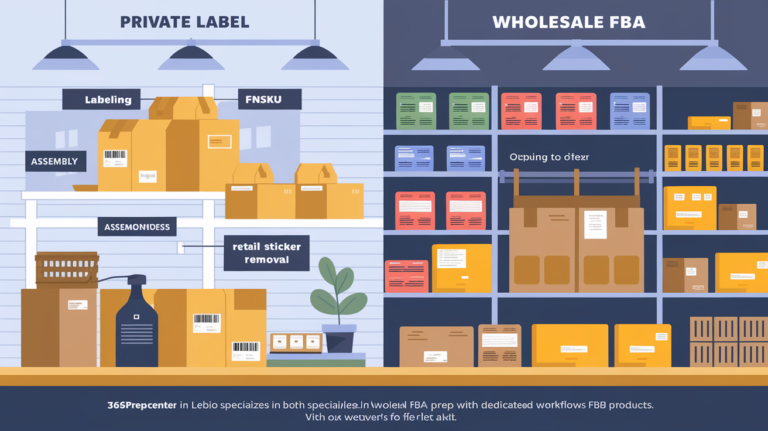

How to Choose an FBA Prep Center: 10-Point Checklist for Amazon Sellers
A seller came to us after losing $4,200 in a single month — not from bad inventory decisions, but from unplanned prep fees at Amazon’s fulfillment centers. His previous 3PL was missing poly bag requirements on a grocery-adjacent product. Amazon caught it at the dock. At $0.52 per unit in unplanned prep fees across 8,000 units, the math was brutal. He didn’t have a bad product. He had the wrong prep center.
Choosing a prep center isn’t a vendor decision. It’s an operational decision. And most sellers don’t treat it that way until something goes wrong. This checklist exists so you can evaluate your options the right way — before a $4,000 mistake makes it obvious.
What Services Does the Prep Center Actually Handle?
Start here. Not every prep center does everything. Some specialize in media. Some won’t touch grocery. Some don’t have the equipment to do bubble wrap or poly bag sealing at scale, so they outsource it or do it slowly by hand — and that cost lands on you.
Ask for a written service list, not a general “yes we do FBA prep.” You want specifics:
- Poly bagging (with suffocation warning printing capability?)
- Bubble wrap and fragile item handling
- FNSKU labeling
- Case pack and mixed-case shipments
- Carton content labels and pallet building
- Kitting and bundling
- Hazmat and oversized item handling
If you’re sourcing private label, you need a center that can handle all of the above without outsourcing steps. If you’re doing retail or online arbitrage, you may only need labeling and inspection — but you still need to know that up front.
Our FBA prep services page lists exactly what we handle, including category-specific requirements. That kind of transparency is table stakes. If a prep center can’t give you a clear service list, keep looking.
How Does Pricing Actually Work — and What Triggers Extra Fees?
Pricing is where sellers get burned most often. Not because prep centers are dishonest, but because most pricing structures have conditional line items that don’t show up until the invoice arrives.
Typical per-unit prep pricing runs $0.50 to $1.75 depending on complexity. Poly bagging a standard item might be $0.25. Add a suffocation warning label and it bumps. Add a bundle and you’re looking at $0.75 to $1.25 per unit all-in. That’s before receiving fees, storage fees, or outbound freight.
Ask specifically about:
- Receiving fees — Some centers charge $25–$45 per pallet received. Some charge per carton. Know which before your first shipment.
- Minimum charges — Small shipments often have minimums. If you send 50 units, you might be billed for 100.
- Storage rates — Short-term vs. long-term, and whether they charge by cubic foot or pallet position.
- Account setup or onboarding fees — Not universal, but they exist.
- Disposal and return handling — What happens to damaged or refused inventory?
Review our Amazon prep center pricing breakdown to see what a transparent rate card actually looks like. Use that as a benchmark when you’re comparing quotes from other centers.
One more thing: always ask whether they charge for Amazon’s FBA shipment creation steps — like generating FNSKU labels or building shipments in Seller Central. Some centers include it. Some bill it separately at $10–$25 per shipment plan.
What’s Their Error Rate and How Do They Handle Mistakes?
Every warehouse makes mistakes. Mislabeled units, wrong quantities, missed prep steps. The question isn’t whether it happens — it’s what happens next.
According to Amazon’s FBA policies, sellers are responsible for ensuring products meet prep and labeling requirements before shipment to fulfillment centers. That means if your prep center sends in items with the wrong FNSKU, Amazon may sticker over it at $0.55 per unit — or reject the shipment entirely. The prep center made the error. You paid for it.
Ask these specific questions:
- What is your QC process for labeling accuracy?
- Do you photograph items before shipping?
- How do you handle discrepancies between units received and units shipped?
- If your team mislabels a unit and Amazon charges an unplanned prep fee, who covers it?
That last question separates serious operations from ones that will leave you disputing invoices for six months. A prep center worth keeping will have a clear policy — either they cover verified errors or they apply a credit. Vague answers here are a red flag.
We see this weekly at our warehouse: sellers who switched to us specifically because their previous prep center had no QC step after labeling. Not a photo check. Not a count verification. Units went out the door unchecked. That’s how 8,000 units end up with the wrong FNSKU on them.
How Fast Can They Turn Inventory Around?
Turnaround time matters more depending on your model. If you’re doing wholesale or private label with stable inventory, a 5–7 business day turnaround might be fine. If you’re doing OA or RA with time-sensitive pricing windows, waiting 10 days is money left on the table.
Ask for their standard and peak-season turnaround commitments in writing. “We’re usually fast” is not a service level agreement.
Things that slow down prep centers that they won’t always volunteer:
- They’re a one-person or two-person operation running out of a garage or small unit. Fine for low volume. Falls apart at Q4.
- They batch prep — meaning they wait until they have a full day’s worth of work before starting. Your 200-unit shipment waits behind 400 units from another client.
- Their receiving dock is only open 3 days per week. You send a shipment Monday; they don’t open it until Thursday.
Also ask: what’s their receiving hours? Do they accept LTL freight? Can they receive pallets without an appointment? For sellers getting direct factory shipments, this matters a lot.
Are They Familiar With Amazon’s Current Prep Requirements — Not Last Year’s?
Amazon updates prep requirements. Categories get added to the restricted list. Bubble wrap requirements change. New product types require specific label placements. A prep center that last reviewed Amazon’s guidelines in 2022 is a liability.
As of the most recent Amazon FBA guidelines, products in certain categories — including topicals, grocery, and fragile items — have specific prep types assigned in Seller Central that must be followed exactly. If your prep center isn’t checking the prep type assigned to each ASIN before prepping it, they’re guessing. And guessing costs money.
Ask them:
- How do you verify what prep type Amazon requires for each ASIN?
- Do you have someone who monitors Amazon policy updates?
- Have you handled [your specific product category] recently?
Category experience matters. A prep center that’s done 50,000 units of supplements has a very different operational reality than one that’s primarily handled books and media. Don’t assume prep is prep.
Honestly, most sellers shouldn’t prep grocery items themselves — the poly bag, suffocation warning, and temperature-sensitivity requirements alone are enough to trip up even experienced operations. That’s a category where getting it wrong at the prep stage ripples into removal orders and lost sales rank.
What Does Their Communication and Client Access Look Like?
This one sounds soft. It isn’t.
We’ve had sellers transfer inventory to us mid-month because their previous prep center was unreachable for 48 hours when a shipment had a problem. No portal access. No real-time inventory count. Email responses taking 3 days. That’s not a communication preference — that’s an operational risk when your inventory is sitting in someone else’s warehouse.
Before committing, find out:
- Is there a client portal or inventory dashboard?
- Can you see receiving status in real time or within 24 hours of delivery?
- Do you get photos of received inventory?
- Who is your point of contact and what are their response time expectations?
- What’s the escalation path if something goes wrong?
And ask to see the portal before you sign anything. A lot of prep centers claim they have “software” that turns out to be a shared Google Sheet updated once a week. That may work for some sellers. For anyone running more than a few hundred units a month, it’s not enough.
The 10-Point Checklist: What to Verify Before You Sign On
Pull this out every time you’re evaluating how to choose an FBA prep center checklist-style. These are the ten non-negotiables — the things that, if you can’t confirm them, you move on.
- Written service list — Every prep type they offer, in writing.
- Transparent pricing with no surprise fees — Full rate card including receiving, storage, and minimums.
- Documented QC process — What happens after labeling, before the box closes.
- Error accountability policy — Who pays when they make a mistake.
- Turnaround SLA — Standard and peak-season, in writing.
- Amazon policy familiarity — Verified for your specific product categories.
- Receiving hours and freight capability — Including LTL, pallets, and blind shipment handling.
- Real-time or near-real-time inventory visibility — Not a spreadsheet emailed on Fridays.
- Named point of contact with response time commitment — Not a generic support inbox.
- References or volume history — At least one seller reference in your category, or documented unit volume they’ve handled.
If a prep center clears all ten, it’s worth a test shipment. Start with 200–300 units. Check the invoice against the quote. Check the turnaround against what they promised. Check Seller Central for any unplanned prep fees after the shipment arrives. That’s your real audit.
Knowing how to choose an FBA prep center by using a structured checklist like this removes the guesswork. You’re not picking based on whoever has the nicest website or the lowest quoted rate. You’re evaluating an operation that will handle your inventory and your Amazon account’s health.
Most sellers who use this approach end up narrowing to two or three real candidates. From there, the test shipment decides it.
A missing poly bag costs $0.04. Amazon’s unplanned prep fee for the same unit is $0.52. Across 5,000 units, that’s $2,400 you could have kept. The right prep center isn’t an overhead expense — it’s what keeps those costs off your P&L.
If you’re working through this how to choose an FBA prep center checklist and want to see what a well-run operation looks like from the inside, 365PrepCenter handles all ten points above. We’re in Lebanon, Ohio — central location, competitive rates, and a rate card that says what it means. Get a free quote and see how we stack up against what you’re paying now.