
Amazon Compliance Requirements 2026: Full Checklist Every Seller Needs
You’ve built a profitable Amazon business — and then a compliance violation hits. A product gets flagged, a shipment gets rejected at the fulfillment center, or worse, your listing gets suspended right before Q4. For experienced sellers, these aren’t hypothetical risks. Amazon’s compliance standards tighten every year, and 2026 is no exception. This amazon compliance requirements checklist 2026 is built for sellers who already know the basics and need a current, actionable reference to protect their account health, keep inventory moving, and avoid costly mistakes before they happen.
Why Amazon Compliance Is More Complex in 2026
Amazon has steadily expanded its compliance enforcement mechanisms over the past three years. Automated systems now flag non-compliant ASINs faster than ever, and the threshold for corrective action has dropped significantly. What a seller could get away with in 2023 — a missing safety warning, an imprecise product title, a loosely applied poly bag — can now trigger a shipment rejection or listing suppression in 2026.
Several forces are driving this shift:
- Regulatory pressure: Amazon is operating under increasing scrutiny from the CPSC, the EU’s General Product Safety Regulation (GPSR), and U.S. state-level requirements, particularly around electronics, children’s products, and food contact materials.
- Stricter FBA inbound requirements: Amazon’s updated Inbound Placement Service rules and revised FBA shipment requirements mean that prep errors now carry financial penalties in addition to rejection.
- Third-party seller accountability: Amazon has made it unambiguously clear in its Seller Central policy updates that sellers — not Amazon — bear responsibility for ensuring products meet all applicable safety and compliance standards before they enter the supply chain.
According to Amazon’s own seller metrics documentation, shipments that fail inbound compliance checks are subject to unplanned service fees that can range from $0.15 to over $1.75 per unit depending on the prep type required. Multiply that across a large shipment and the cost of non-compliance becomes immediately tangible.
Understanding the full scope of the amazon compliance requirements checklist 2026 means looking at product-level compliance, packaging and prep compliance, listing compliance, and account-level documentation — all four layers working together.
Product-Level Compliance: What You Must Verify Before You List
Product compliance is the foundation. If your product doesn’t meet applicable legal and platform safety standards, no amount of great packaging or optimized listings will protect you from enforcement action.
Safety Standards and Testing Documentation
Amazon requires that sellers of regulated product categories maintain current test reports from CPSC-recognized, accredited third-party laboratories. Categories with active enforcement in 2026 include:
- Children’s products (toys, car seats, cribs, clothing)
- Electronics and batteries (including lithium-ion compliance under UN 38.3)
- Food contact materials and food supplements
- Personal care and cosmetics (FDA compliance and ingredient documentation)
- Helmets, safety gear, and protective equipment
- Furniture subject to ASTM F2057 (clothing storage units) and similar standards
Test reports must reference the current version of applicable standards. An ASTM F963-17 test report will not satisfy requirements if the current standard is ASTM F963-23. Sellers sourcing from overseas should verify this proactively with their factories — labs sometimes issue reports against outdated standards without flagging it.
Certificates of Conformity and Compliance Documentation
Beyond test reports, many categories require a Children’s Product Certificate (CPC) or General Conformity Certificate (GCC). These documents must be produced by the manufacturer or importer and must reference the applicable standards, the certifying party’s name, and the contact information of the testing lab. Amazon can request these at any time, and failure to produce them within the required window — typically 72 hours — can result in ASIN suspension.
Chemical Compliance
California Proposition 65, REACH (for EU-targeted listings), and restricted substance lists from CPSC are all active enforcement areas. If your product contains any of the 900+ substances on the Prop 65 list above safe harbor thresholds, proper warning labeling is required. This applies to products sold or shipped into California, which represents a significant share of U.S. Amazon volume.
FBA Packaging and Prep Compliance Checklist
This is where many experienced sellers still lose money. FBA prep requirements are detailed, category-specific, and enforced at the fulfillment center. A rejected or unplanned service fee shipment is expensive; a pattern of non-compliant shipments can result in receiving limitations or removal from certain inbound routes.
If you’re not using a dedicated prep service, reviewing the FBA prep requirements and services at 365PrepCenter can help you understand what a professional operation handles on your behalf.
Poly Bag Requirements
- All poly bags must be at least 1.5 mil thick
- Bags with an opening of 5 inches or larger must display a suffocation warning, either printed on the bag or on a label attached to the bag
- Warning text must be in a minimum 10-point font
- Bags must be completely sealed if the product could be considered a suffocation hazard
- No tape may be used as a substitute for a sealed bag on eligible products
Bubble Wrap and Fragile Item Prep
- Fragile items must be wrapped so that the item does not move when the package is shaken and can withstand a 3-foot drop test
- The packaged unit must fit on a standard conveyor belt without tipping or jamming
- Glass items require specific five-sided protection or rigid packaging
Labeling Requirements
- Every unit must have a scannable FNSKU barcode that is the outermost barcode on the product
- Original manufacturer barcodes must be covered if seller-labeled items are being sent (not commingled with Stickerless inventory)
- Shipment labels must be applied to the largest flat surface of the box and must not be covered, folded, or obscured
- Expiration dates must be visible and formatted MM/DD/YYYY or MM/YYYY — no other formats are accepted at inbound
Expiration-Dated and Consumable Products
- Products must have a minimum remaining shelf life of 90 days at the time of inbound receipt
- Expiration dates must be printed on the outer packaging and on each individual unit
- Lot numbers are required for ingestible and topical products in many categories
Hazmat and Dangerous Goods
Any product containing aerosols, flammable materials, lithium batteries, or controlled substances falls under Amazon’s Dangerous Goods (Hazmat) program. These products require Safety Data Sheets (SDS) and may require an Exemption Sheet. Amazon’s Dangerous Goods classification tool in Seller Central is the official resource, but it’s worth reviewing any product with these characteristics before sending inventory to FBA. Misclassified hazmat products can result in inventory disposal at your expense.
Listing Compliance: Title, Images, and Restricted Claims
Amazon’s listing compliance enforcement has expanded significantly, and in 2026, automated detection systems are scanning listings for policy violations in real time. This section of the amazon compliance requirements checklist 2026 covers what triggers suppression and what to audit regularly.
Title and Bullet Point Compliance
- Product titles must not exceed character limits (typically 200 characters for most categories, fewer for some)
- Titles must not contain promotional phrases such as “best seller,” “cheapest,” or “top rated”
- All-caps titles or excessive capitalization will trigger suppression
- Bullet points must describe product features — not marketing copy, warranty terms, or unsubstantiated claims
Restricted Claims by Category
This is an area where even experienced sellers make costly errors. Restricted claims include:
- Health and supplement listings: Structure/function claims are permitted; disease claims are not. Statements like “treats diabetes” or “cures inflammation” are prohibited and will trigger listing removal and potential account review.
- Pesticides and antimicrobials: Any claim that a product kills, repels, or prevents bacteria, viruses, or insects triggers EPA registration requirements. This includes “antimicrobial,” “antibacterial,” and “kills 99.9% of germs.”
- Medical devices: Products marketed for diagnosis, treatment, or prevention of medical conditions require FDA clearance and proper classification before they can be listed.
Image Compliance
- Main image must be on a pure white background (RGB 255, 255, 255)
- Product must occupy at least 85% of the image frame
- No watermarks, logos, text overlays, or borders on the main image
- Secondary images must not include inaccurate lifestyle claims or misleading comparison graphics
Account-Level Compliance: Documentation, Invoices, and Brand Registry
Listing and product compliance gets most of the attention, but account-level compliance is what determines whether you stay on the platform long-term. Amazon has increased the frequency of account-level audits, particularly for sellers in gated categories or those above certain revenue thresholds.
Invoice Requirements for Ungating and Sourcing Verification
Amazon’s invoice verification standards are strict and enforced consistently in 2026. Valid invoices for sourcing verification must:
- Be dated within 365 days of the request
- Show the supplier’s name, address, and phone number
- Show your business name and address as the buyer
- List the product by name and/or ASIN with quantities
- Not be altered, redacted for price, or generated from a personal PayPal or peer-to-peer payment
Retail receipts from Walmart, Target, or similar sources are not accepted as valid sourcing documentation for most categories. This is a common mistake for sellers transitioning from retail arbitrage into wholesale or private label.
Brand Registry and IP Compliance
If you’re operating under your own brand, Brand Registry enrollment is no longer optional for serious sellers in 2026. It provides access to IP protection tools, A+ Content, Sponsored Brand ads, and the ability to respond to IP complaints. Without it, you’re vulnerable to hijackers and counterfeit sellers on your listings with limited recourse.
Sellers who receive IP complaints — whether legitimate or not — must respond through the proper appeals process with evidence of authorization or ownership. Ignoring IP complaints is the fastest route to a suspended account.
Tax and Business Documentation
- Ensure your W-9 or W-8BEN is current and matches your selling account information
- Verify that your state sales tax nexus registrations are current — Amazon collects Marketplace Facilitator Tax in all applicable states, but sellers remain responsible for states where they have independent nexus
- Keep your business address, primary contact, and bank account information updated in Seller Central to avoid payment holds
How a Professional 3PL Reduces Your Compliance Risk
Managing the full amazon compliance requirements checklist 2026 internally is operationally demanding. Between keeping up with policy updates, training staff, and maintaining quality control across SKUs, compliance management is a legitimate operational cost — and one that scales poorly when you’re managing it in-house.
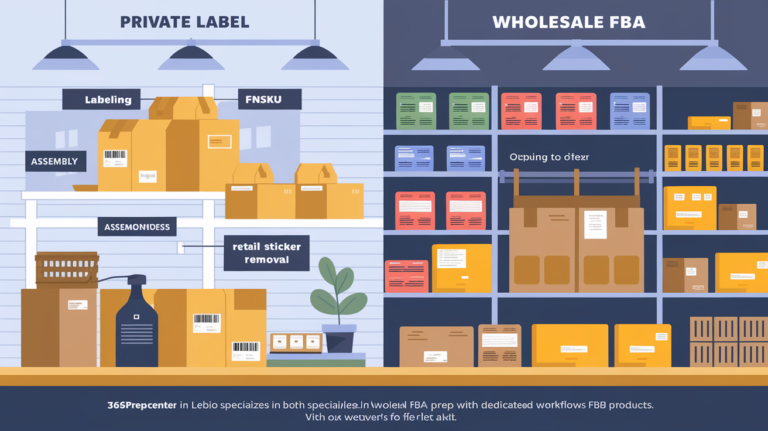
Working with a specialized FBA prep center changes that equation. At 365PrepCenter in Lebanon, Ohio, compliance-aware prep is built into the standard workflow. That means poly bag specs, FNSKU labeling, expiration date checks, fragile item protocols, and hazmat flagging are all handled before your inventory ever reaches an Amazon fulfillment center. Review our full prep and fulfillment services to see how we handle compliance at every stage of the inbound process.
The operational advantage is straightforward: a single unplanned service fee on a 500-unit shipment can cost $250–$875 depending on prep type. Outsourcing prep to a qualified 3PL eliminates that exposure while freeing your time to focus on sourcing, scaling, and strategy.
Your 2026 Amazon Compliance Quick-Reference Checklist
Use this consolidated checklist as part of your standard operating procedure for any new product launch or inbound shipment in 2026:
Product Compliance
- Current third-party test report from accredited lab against the latest applicable standard
- CPC or GCC on file for regulated categories
- SDS and exemption sheet prepared for any hazmat-adjacent product
- Prop 65 compliance reviewed for U.S. distribution
- FDA registration or clearance confirmed for applicable food, supplement, or device products
Packaging and Prep Compliance
- Poly bags meet 1.5 mil minimum and include suffocation warning where required
- FNSKU barcode applied and scannable on every unit
- Expiration dates visible and formatted correctly
- Fragile items pass internal drop-test standard
- Shipment boxes within Amazon’s weight (50 lbs max) and dimension limits
- Box content information submitted accurately in Seller Central before shipment
Listing Compliance
- Title within character limits, no prohibited phrases
- No restricted claims in bullets, description, or A+ Content
- Main image on white background, product fills frame
- Backend keywords contain no prohibited or irrelevant terms
Account-Level Compliance
- Sourcing invoices current, complete, and stored securely
- Brand Registry active if you own a private label brand
- W-9 / W-8BEN current and accurate
- Business information in Seller Central up to date
- Open IP complaints addressed promptly with documentation
Running through this amazon compliance requirements checklist 2026 before every product launch and every major inbound shipment is the operational habit that separates sellers who scale without disruption from those who spend Q4 filing appeals instead of fulfilling orders.
Ready to simplify your FBA prep? 365PrepCenter in Lebanon, Ohio handles everything — get a free quote.