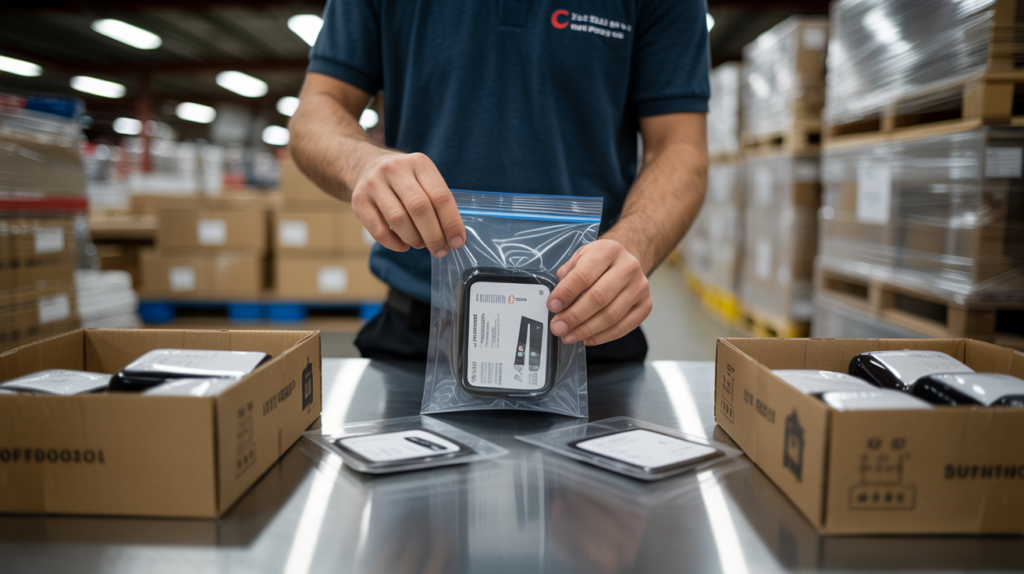
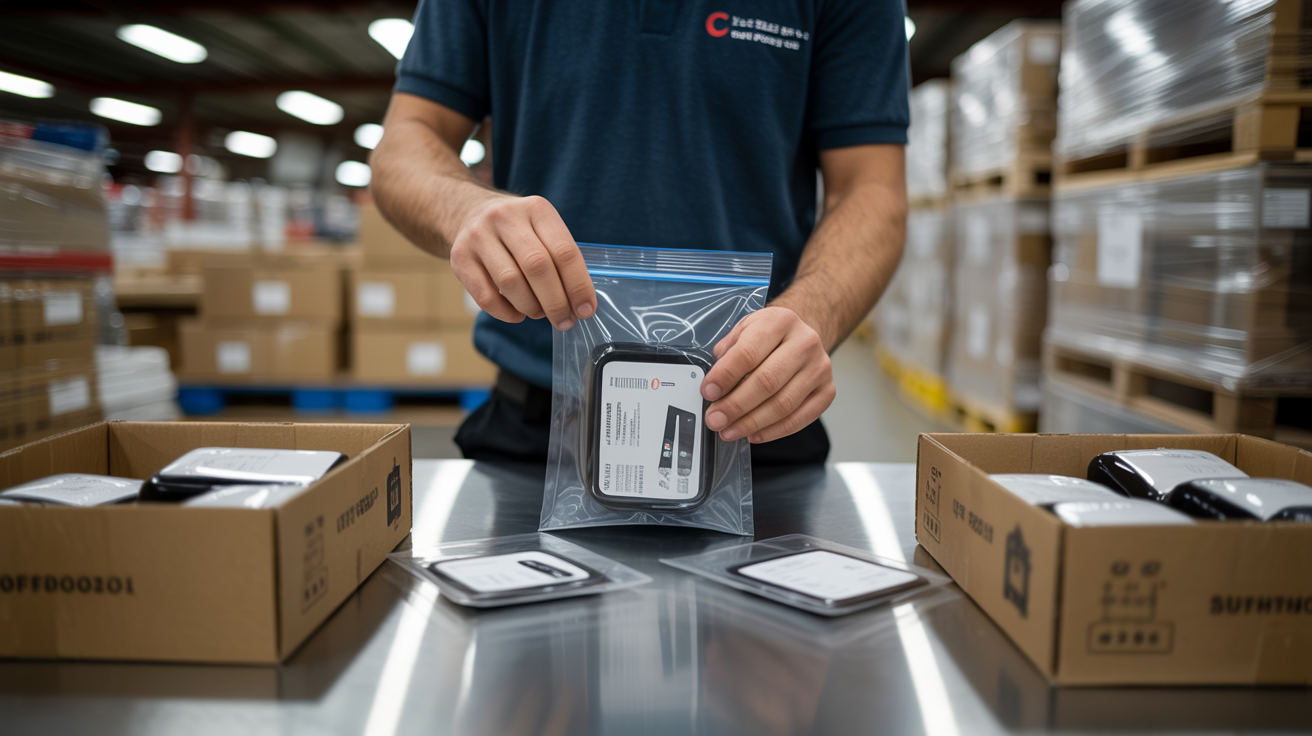
Kitting sounds simple until you're standing at a table with 500 units of one SKU and 500 of another, trying to figure out how many hands you actually need to hit a ship date. We do kitting and bundling every week at our Lebanon, Ohio warehouse, and the requests that come in are almost never as straightforward as the seller expects. Some want a simple 2-item gift set. Others want six components shrink-wrapped together with an insert card that has to sit face-up. Both are "kitting" on paper. In practice they're completely different jobs.
I want to walk through how we actually price and run kitting for Amazon products, because the pricing tiers alone don't tell you much without the context of why they're structured that way.
Why Kitting Pricing Scales the Way It Does
Our rates run by set size: $1.20/set for 2-3 units, $1.50/set for 4-5 units, and $1.75 for a 6-unit set, plus $0.20 for each unit beyond six. That jump isn't arbitrary. A 2-unit kit — say, a phone case bundled with a screen protector — takes one person maybe 8-10 seconds to assemble and bag. A 6-piece kit means checking six separate SKUs are present, in the right orientation, before it goes into poly or a printed box. More components means more chances for Tatiana's team to catch a wrong item at the table, which is exactly the point of doing it by hand rather than trying to shortcut the count.
There is no minimum order quantity on kitting. A test batch to validate packaging or run a small Vine promotion before committing to volume is fine — that's a conversation we have upfront, not something buried in fine print. What we won't do is run 40 sets at full kitting rates and eat the labor setup cost on our end for something that small. It doesn't work economically for either of us.
What We Actually Check Before Assembly Starts
This is the part that gets skipped when people think about kitting as just "putting things in a bag together." Before any kit gets built, we verify quantities against the packing list on both component SKUs — not just one. We've had cases where a seller ships 1,000 units of Component A and 950 of Component B, expecting 1,000 finished sets. That math doesn't work, and catching it before assembly starts (rather than after 950 kits are built and 50 units of A are sitting orphaned) saves everyone a headache and a reshipment.
We also check whether Amazon's listing requires the kit to be sold under one new FNSKU or whether it's a "Frequently Bought Together" virtual bundle that doesn't need physical kitting at all. Sellers occasionally send us kitting requests for products that don't need physical combination — a quick label check on the Amazon side, before units hit our dock, saves the kitting fee entirely.
For anything requiring FNSKU labeling on the finished kit, that runs through our standard FBA prep tiers — $1.00/unit at 1-50 units, dropping to $0.35/unit at 1000+ — layered on top of the kitting fee itself, since labeling and assembly are two separate touches on the product.
Turnaround and What Slows It Down
Simple 2-3 unit kits with no special packaging move fast — usually within our standard 24-48 hour FBA prep window once components have both arrived and been counted in full. Where it slows down is custom poly bags, printed inserts that need specific placement, or shrink-wrap that has to cure before boxing. If you're supplying your own kitting materials (bags, inserts, tape), get them to us before or with the product — not after. We've had sets sit half-finished for three days waiting on a box of poly bags stuck in transit separately from the product itself.
Storage on partially-kitted inventory works the same as regular storage: $1/cubic foot per month, the first 7 days after receiving free. If your components arrive weeks apart, that clock is already running on whatever's sitting here waiting for its partner SKU.
One Thing Worth Saying Plainly
Kitting adds a labor step, a QC step, and usually a packaging cost on top of your existing per-unit product cost. It's worth it when the bundle genuinely increases average order value or solves a listing problem — bundling accessories that always sell together, or combining slow movers with fast ones. It's not worth it as a workaround for inventory you're trying to move creatively. We'll tell you that directly if that's what a kitting request looks like, because running a few hundred sets you can’t sell doesn’t help either of us.
FAQ
What's the minimum order for kitting services? There isn’t one. We’ll run a small test batch as readily as a large one, which is usually what sellers want when they’re validating a new bundle before committing to full volume.
Do you charge kitting fees and FBA prep labeling fees separately? Yes. Kitting fees ($1.20-$1.75/set depending on set size) cover assembly and packaging. If the finished kit needs a new FNSKU label, that's billed at standard FBA prep rates on top.
Can I ship kit components to you at different times? Yes, but kits can't be assembled until all components for that batch have arrived and been counted. Storage charges apply to anything sitting here waiting on its counterpart SKU, after the first 7 days free.
What happens if my component quantities don't match? We flag it before assembly, not after. If you send 1,000 of one SKU and 950 of another, we'll confirm with you how to proceed — build 950 complete sets and hold the excess, or wait on a reshipment — rather than guessing.
Ready to see if kitting makes sense for your SKUs? Head to our onboarding page and tell us what you're bundling — we'll tell you straight whether it's worth doing.